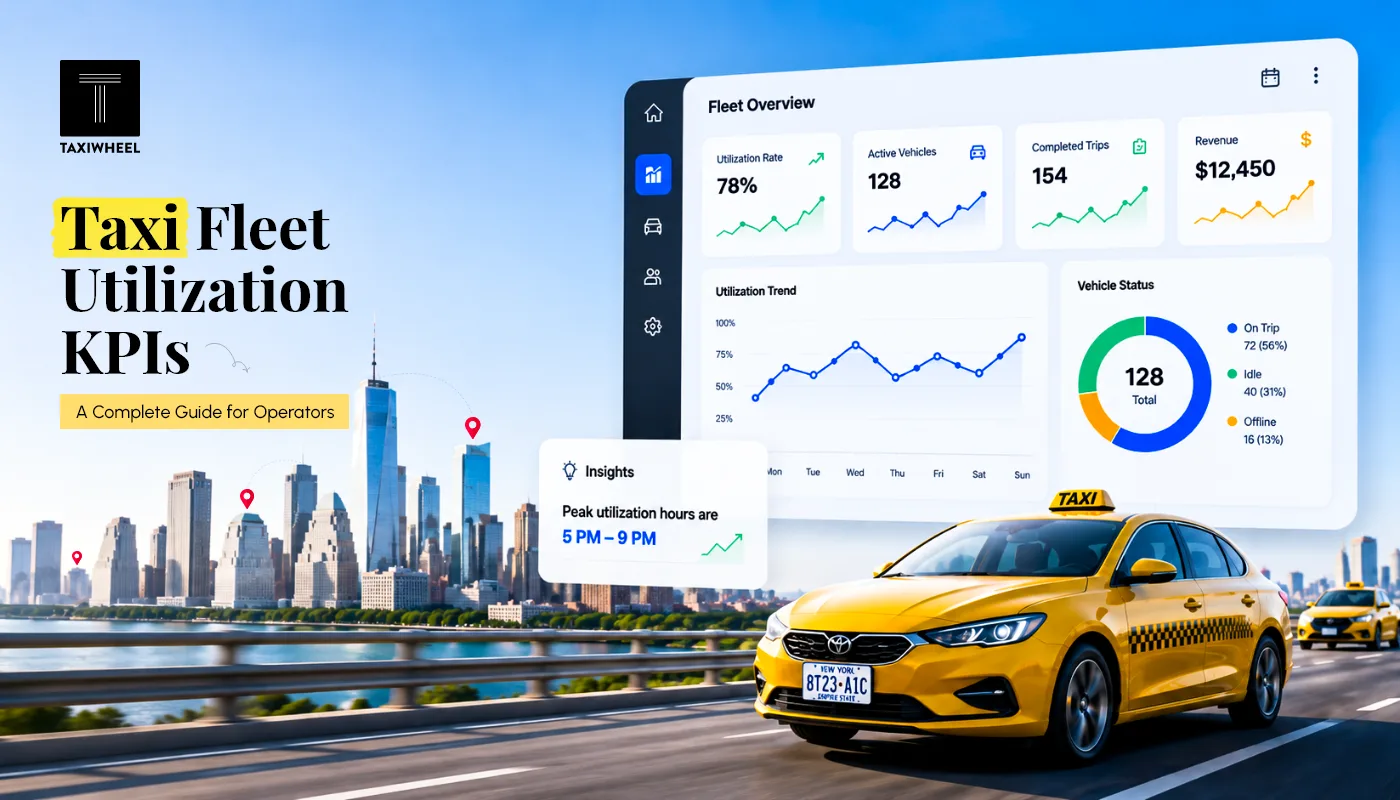
Fleet Utilization KPI Guide for Taxi Businesses
Fleet utilization shows how effectively a taxi company uses its available vehicles to complete revenue-generating trips. A strong utilization system tracks more than whether a car is moving. It also measures occupied time, empty mileage, driver availability, downtime, trip completion, cost and customer demand.
Taxi operators can calculate utilization by dividing productive vehicle time by total available vehicle time and multiplying the result by 100. However, there is no universal “good” utilization percentage for every taxi business. The right target depends on operating hours, demand patterns, maintenance requirements, service areas and fleet size.
Modern taxi fleet management software can collect booking, dispatch, location, driver and trip data in one place, making these KPIs easier to monitor consistently.
Key Takeaways
- Taxi fleet utilization measures productive vehicle use against available capacity.
- Track occupied hours, trip completion, empty mileage, downtime and cost per trip together.
- Do not judge performance from utilization percentage alone.
- Compare vehicles, shifts and service zones using consistent definitions.
- A taxi dispatch app can help connect ride, driver and vehicle data for faster operational decisions.
What is Fleet Utilization in a Taxi Business?
Fleet utilization measures how much of a taxi fleet’s available capacity is being used productively.
For a taxi company, productive use may mean:
- Carrying a paying passenger
- Travelling to an assigned pickup
- Completing a contracted corporate trip
- Operating within an approved service shift
Idle time, unplanned downtime and long periods without assignments usually reduce utilization.
The exact definition must remain consistent. One operator may count the drive to a pickup as productive time, while another may count only passenger-occupied time. Both methods can work, but changing the definition between reports makes comparisons unreliable.
Fleet specialists commonly describe vehicle utilization as the relationship between productive usage and available or scheduled capacity. They also recommend defining both “productive work” and “available time” before calculating the percentage.
How Do You Calculate Taxi Fleet Utilization?
The basic fleet utilization formula is:
Fleet Utilization Rate = Productive Vehicle Time ÷ Available Vehicle Time × 100
For example, assume ten taxis are each available for ten hours:
- Total available time: 10 vehicles × 10 hours = 100 vehicle-hours
- Productive time: 72 vehicle-hours
- Fleet utilization: 72 ÷ 100 × 100 = 72%
This is an illustrative calculation, not an industry benchmark.
Taxi companies can also calculate utilization in several ways.
| Utilization method | Formula | What it shows |
| Time utilization | Productive hours ÷ available hours × 100 | How much available time generates operational value |
| Trip utilization | Completed trips ÷ accepted or assigned trips × 100 | How reliably the fleet fulfils bookings |
| Distance utilization | Passenger or productive kilometres ÷ total kilometres × 100 | How much travel is productive |
| Vehicle utilization | Active vehicles ÷ available vehicles × 100 | How much of the physical fleet is deployed |
A taxi operator should select one primary formula and use secondary measures to explain the result. A vehicle may have high operating hours but still perform poorly if it travels excessive empty kilometres or completes low-value trips.
What Are the KPIs for Fleet Management?
The main fleet management KPIs cover utilization, cost, maintenance, driver performance, safety and service delivery. For taxi businesses, the most useful metrics are those that connect vehicle activity with completed rides and revenue.
- Fleet utilization rate: This shows the percentage of available fleet capacity used productively.
- Passenger-occupied rate: Passenger-Occupied Rate = Passenger Time ÷ Total Active Time × 100. This separates paid passenger time from cruising, waiting and pickup travel.
- Empty mileage percentage: Empty Mileage = Non-passenger Kilometres ÷ Total Kilometres × 100. A high empty mileage percentage may indicate poor vehicle positioning, inefficient dispatching or weak demand in certain zones.
- Trips per vehicle: Trips per Vehicle = Completed Trips ÷ Active Vehicles. Review this by hour, shift, day and service area rather than only at fleet level.
- Trip completion rate: Trip Completion Rate = Completed Trips ÷ Confirmed Trips × 100. This helps identify cancellations, missed pickups and dispatch failures.
- Vehicle downtime: Track the hours or days when a taxi is unavailable because of maintenance, repair, inspection or administrative issues.
- Cost per kilometre or mile: Geotab defines cost per mile as total cost of ownership divided by total distance travelled. Total cost may include fixed expenses such as insurance and registration, plus variable expenses such as fuel, tolls and mileage-related maintenance.
- Fuel or energy efficiency: Track fuel consumption or electric energy use by vehicle, route and driver.
- Average pickup time: Measure the time between booking confirmation and driver arrival.
- Driver acceptance and cancellation rates: These KPIs help operators identify assignment issues, driver availability gaps and service-zone problems.
Fleet-management guidance commonly groups KPIs around costs, utilization, driver performance, safety, maintenance and operational efficiency.
What Are the 5 Pillars of Fleet Management?
There is no single universally mandated five-pillar model for fleet management. Taxi businesses can use the following practical framework to organize their KPIs.
- Vehicle utilization: Measure active time, occupied time, trips per vehicle and empty mileage.
- Driver management: Track availability, acceptance rate, cancellations, safety events and service ratings.
- Dispatch and demand management: Compare bookings, pickup times, assignment speed and demand by zone.
- Maintenance and cost control: Monitor downtime, preventive maintenance, repairs, fuel use and operating cost.
- Customer service and compliance: Track completed rides, complaints, ratings, response times and required vehicle or driver documentation.
These pillars should work together. Increasing vehicle activity without protecting maintenance windows can create breakdowns. Reducing idle time without considering demand may place too many drivers in low-booking areas.
How Do You Measure Fleet Performance?
Measure fleet performance by defining a business objective, selecting relevant KPIs, establishing consistent formulas and reviewing trends over time.
A practical measurement process includes:
- Set the objective. Decide whether the priority is more completed rides, lower empty mileage, faster pickups or reduced operating cost.
- Define each metric. Specify what counts as productive time, available time and downtime.
- Collect reliable data. Use trip records, GPS data, dispatch events, driver status and maintenance logs.
- Segment the results. Compare by vehicle, driver, shift, zone and day.
- Review trends. Compare current results with previous weeks or months.
- Investigate exceptions. Identify vehicles or shifts performing far above or below the fleet baseline.
- Take action and measure again.
What Is a Good Fleet Utilization Rate for a Taxi Company?
A suitable target depends on:
- Whether the fleet operates 8, 12 or 24 hours
- Peak and off-peak booking demand
- Driver shift arrangements
- Airport, city, corporate or medical transport work
- Vehicle maintenance schedules
- Local traffic conditions
- How productive time is defined
A 75% rate based on total active time is not directly comparable with a 75% passenger-occupied rate. The first may include pickup travel, while the second may count only paid passenger time.
Taxi operators should begin with an internal baseline. Calculate the same KPI for several comparable weeks, then set improvement targets by shift and service zone. The aim is not 100% continuous use. Vehicles still require cleaning, charging or refuelling, inspections, driver breaks and preventive maintenance.
How Can Taxi Businesses Improve Fleet Utilization?
Taxi businesses can improve fleet utilization by matching vehicle supply with demand, reducing empty movement and shortening avoidable downtime.
- Use demand-based scheduling: Place more vehicles on duty during proven booking peaks rather than maintaining the same supply throughout the day.
- Improve vehicle positioning: Use historical pickup data to position available taxis closer to likely demand zones.
- Automate ride assignment: A modern taxi dispatch software platform can assign and monitor rides, manage drivers and vehicles, and track performance metrics through a central panel. TaxiWheel describes these capabilities within its admin and dispatch system.
- Reduce cancellations: Review why riders and drivers cancel. Common operational causes may include long arrival times, poor assignment logic or incorrect availability status.
- Plan preventive maintenance: Schedule service during low-demand periods where possible. This protects availability during peak hours without delaying necessary maintenance.
- Track performance by segment: A fleet-wide average can hide weak vehicles, drivers or zones. Review utilization at a more detailed level.
- Connect booking and fleet data: A white label taxi app that combines rider booking, driver workflows, dispatch and administration can create a more complete operational data trail. TaxiWheel’s platform includes passenger, driver and admin or dispatcher components, along with real-time requests, navigation, availability status and trip information.
How Do You Audit Fleet Management?
A fleet audit checks whether vehicles, drivers, costs, processes and data are being managed accurately and consistently.
Use the following audit process:
- Confirm the fleet inventory: Verify every active, inactive, leased, reserved and maintenance vehicle.
- Review utilization data: Compare scheduled availability with active time, occupied time and completed trips.
- Reconcile trip records: Check whether booking, dispatch, GPS and payment records match.
- Examine maintenance compliance: Review scheduled servicing, breakdowns, repeat repairs and unavailable days.
- Check driver records: Confirm licensing, availability, performance, safety and cancellation data.
- Review operating costs: Reconcile fuel, charging, repairs, insurance, tolls and vehicle-related expenses.
- Test KPI definitions: Ensure teams use the same meaning for terms such as active, available, occupied and idle.
- Document actions: Assign responsibility, deadlines and expected outcomes for every issue found.
Quarterly utilization reporting can help organizations identify and improve underused fleet assets throughout the year.
How Taxi Fleet Management Software Supports KPI Tracking?
Manual reports can become inconsistent when booking, driver, vehicle and payment data are stored separately. Taxi fleet management software brings operational information into one system so managers can monitor trips and investigate exceptions faster.
TaxiWheel provides a customizable taxi solution with passenger, driver and admin or dispatcher interfaces. Its published features include real-time ride requests, driver availability, navigation, trip information, estimated arrival times and multiple payment options.
A taxi dispatch app should support operational decisions rather than simply display vehicle locations. Before selecting a system, confirm which KPIs it can calculate, what data it records, how reports are exported and whether definitions can be adapted to your business model.
Conclusion
Fleet utilization is one of the most useful taxi management KPIs, but it should never be reviewed alone. Combine it with passenger-occupied time, empty mileage, trips per vehicle, completion rate, downtime and operating cost.
Start by defining productive and available time clearly. Establish your own baseline, compare similar periods and investigate performance by vehicle, shift and zone. With consistent data and suitable taxi dispatch software, taxi businesses can improve fleet allocation without relying on unsupported industry averages.
Turn Every Taxi into a Better-Performing Business Asset
Optimize dispatch, reduce idle time, and improve fleet performance with TaxiWheel.
Frequently Asked Question
Fleet utilization measures how much available vehicle capacity is used for productive taxi operations. It helps operators identify idle vehicles, weak shifts, excessive empty travel and avoidable downtime. The metric is most useful when reviewed with trip completion, cost, maintenance and passenger-occupied time.
Divide productive vehicle time by total available vehicle time and multiply by 100. For example, 72 productive hours divided by 100 available hours equals 72% utilization. Define productive and available time before calculating so reports remain consistent.
There is no universal good rate for every taxi company. The correct target depends on fleet hours, demand, service type, maintenance and the utilization formula used. Establish a historical baseline, compare similar shifts and improve performance without compromising safety or maintenance.
Taxi businesses can improve utilization through demand-based scheduling, better vehicle positioning, faster dispatching, fewer cancellations and preventive maintenance. They should also compare performance by vehicle, driver, shift and service zone to identify where underutilization occurs.
Taxi companies should track fleet utilization, passenger-occupied rate, empty mileage, trips per vehicle, trip completion, pickup time, downtime, fuel efficiency, cost per kilometre and driver cancellations. Together, these metrics show productivity, cost, reliability and customer-service performance.
Recent Blogs
Taxi dispatch software is a centralized platform that automates ride booking, driver assignment, trip tracking, payments and fleet management. It helps taxi operators reduce manual coordination, improve driver utilization, shorten passenger wait times and manage daily operations from a single dashboard. As customer expectations shift toward faster bookings, real-time tracking and cashless payments, relying on […] Read more

A taxi app API is a software interface that allows a ride-booking platform to exchange data with maps, payment gateways, notification services, dispatch systems, and other external technologies. APIs form the operational backbone of modern ride hailing apps. They help passengers find pickup locations, allow drivers to receive trip requests, calculate routes and fares, process […] Read more

Taxi apps are no longer just about booking a ride and tracking a driver. In 2026, AI is quietly powering the decisions that happen behind every smooth trip. It helps taxi businesses assign drivers faster, predict demand, calculate smarter fares, reduce waiting time, and improve customer support. For fleet owners, startups, and transport operators, this […] Read more